TransScript® Uni All-in-One First-Strand cDNA Synthesis SuperMix for qPCR (One-Step gDNA Removal)
耐高温全预混第一链cDNA合成试剂盒(一步法去除gDNA)(用于qPCR)
目录号: AU341-02
单 价:¥6110
产品详情介绍
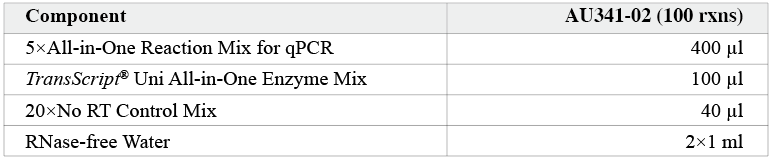
TransScript® Uni All-in-One First-Strand cDNA Synthesis SuperMix for qPCR (One-Step gDNA Removal)包含反转录反应所需的全部成分(TransScript® Uni RT, RNase Inhibitor, Anchored Oligo(dT)20 Primer, Random Primer(N9), dNTPs, Buffer),可在同一管反应中实现cDNA 合成和去除基因组DNA。反应时,只需加入5×All-in-One Reaction Mix for qPCR、TransScript® Uni All-in-One Enzyme Mix、模板RNA和水,在42℃-65℃条件下即可高效地合成第一链cDNA,同时去除RNA模板中残留的基因组DNA 。另配有20×No RT Control Mix,用于配制无反转录酶的对照,判断qPCR模板是否来自cDNA。该产品操作简便,降低操作过程中的污染机率。cDNA产物只适用于qPCR,不适用于常规PCR。
线性范围广
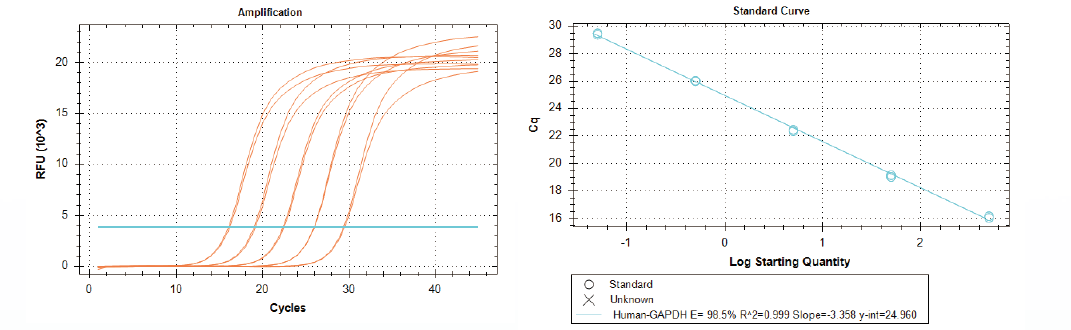
使用 TransGen 产品,以不同起始量 RNA(500 ng-50 pg,10 倍梯度稀释)为模板进行反转录后定量扩增 GAPDH 基因。结果表明, TransGen 产品具有强的反转录效率,模板起始量可达 50 pg。
适用物种范围广
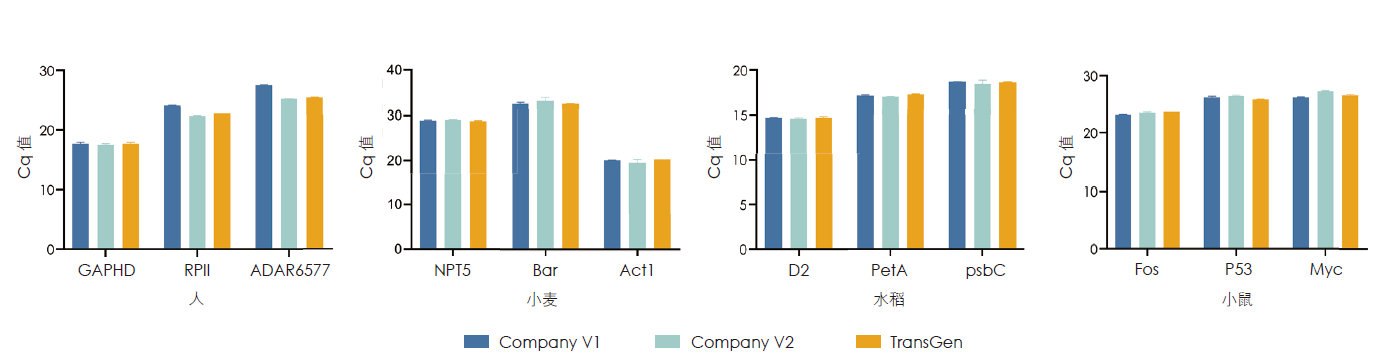
使用 Company V1、Company V2、TransGen 产品,以不同物种 RNA 为模板进行反转录后定量扩增不同基因。结果表明, TransGen 产品可适用于多种物种。
基因组DNA去除能力强
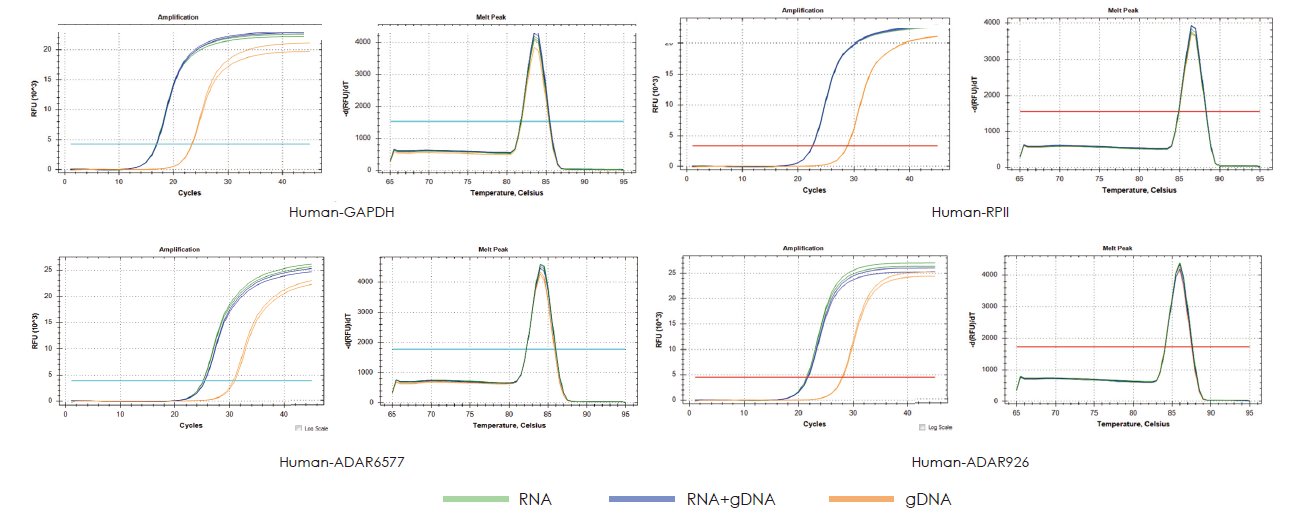
使用 TransGen 产品,以 200 ng RNA、 200 ng RNA+200 ng gDNA、 200 ng gDNA 为模板进行反转录后定量扩增不同基因。结果表明, TransGen 产品具有强的 gDNA 去除能力。
批间稳定性好
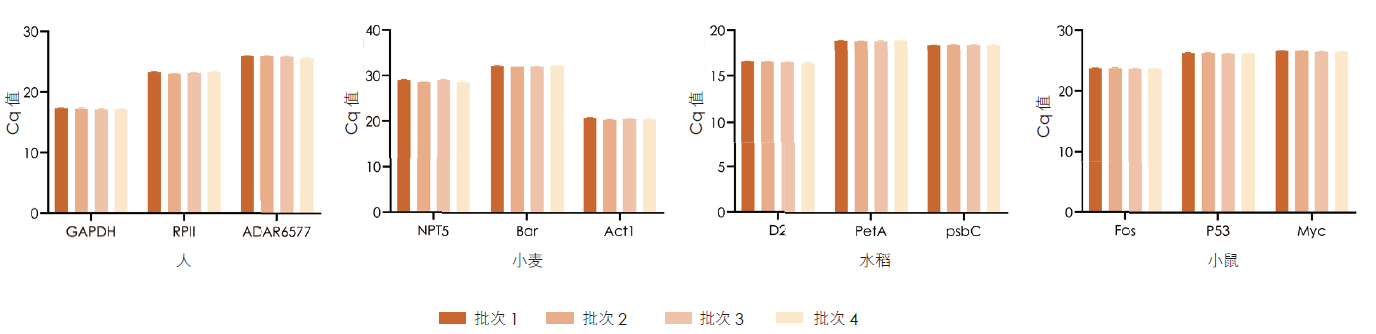
使用不同批次 TransGen 产品,以不同物种 RNA 为模板进行反转录后定量扩增不同基因。结果表明,不同批次间 TransGen 产品的稳定性好。
 <
<
Qin T, Zhang G, Zheng Y, et al. A population of stem cells with strong regenerative potential discovered in deer antlers[J]. Science, 2023.(IF 56.90)
Fan T, Xiao C, Liu H, et al. CXXC finger protein 1 (CFP1) bridges the reshaping of genomic H3K4me3 signature to the advancement of lung adenocarcinoma[J]. Signal Transduction and Targeted Therapy, 2023.(if 39.30)
Li X, Zhang K, Yang X, et al. The cytokine CSBF inhibits the IL-17A and TNF-α inflammatory pathways via SUSD2-ACT1 in keratinocytes and alleviates IMQ-induced psoriasis[J]. Cellular & Molecular Immunology, 2025.(IF 19.80)
Ding X, Xing X, Liu J, et al. Cobweb‐Inspired Microenvironment‐Targeting Nanosystem with Sequential Multiple‐Stage Stimulus‐Response Capacity for Ischaemic Tissue Repair[J]. Advanced Functional Materials, 2023.(IF 19.00)
Chen N, Guo L, Wang L, et al. Sleep fragmentation exacerbates myocardial ischemia‒reperfusion injury by promoting copper overload in cardiomyocytes[J]. Nature Communications, 2024.(IF 14.70)
He L, Ma S, Ding Z, et al. Inhibition of NFAT5‐Dependent Astrocyte Swelling Alleviates Neuropathic Pain[J]. Advanced Science, 2024.(IF 14.30)
Li C, Tan Y P, Gao D, et al. IRE1α RNase activity is critical for early embryo development by degrading maternal transcripts[J]. Nucleic Acids Research, 2025.(IF 13.10)
Li M, Hu Z, Huang Y, et al. BiFC and FACS-based CRISPR screening revealed that QKI promotes PABPN1 LLPS in colorectal cancer cells[J]. Protein & Cell, 2025.(IF 12.80)
Kong X, Tan S, Guan M, et al. Nanocarrier-mediated transdermal delivery of Lmidgf4 dsRNA expedites biological control of locusts by Beauveria bassiana[J]. Journal of Nanobiotechnology, 2025.(IF 12.60)
Wei B, Liu Y, Lyu M, et al. Natural variation in CHELATASE SUBUNIT IA increases grain weight and enhances wheat yield[J]. The Plant Cell, 2025.(IF 11.60)
Cheng H, Liu S, Zhang Y, et al. Comparative single-cell transcriptomic map reveals divergence in leaves between two cotton species at cell type resolution[J]. Journal of Advanced Research, 2025.(IF 11.40)
Liao R, Wu Y, Qin L, et al. BCL11B and the NuRD complex cooperatively guard T‐cell fate and inhibit OPA1‐mediated mitochondrial fusion in T cells[J]. The EMBO Journal, 2023.(IF 11.40)
Liang X, Liu J, Liu X, et al. LINP1 represses unfolded protein response by directly inhibiting eIF2α phosphorylation to promote cutaneous squamous cell carcinoma[J]. Experimental Hematology & Oncology, 2023.(IF 10.90)
Yang S, Li W, Bai X, et al. Ginseng-derived nanoparticles alleviate inflammatory bowel disease via the TLR4/MAPK and p62/Nrf2/Keap1 pathways[J]. Journal of Nanobiotechnology, 2024.(IF 10.60)