文章信息
文章题目:TPPP/p25 amyloid seeding activity as a specific biomarker for multiple system atrophy
期刊:Cell
发表时间:2026 年 5 月 26 日
主要内容:中国上海交通大学 Bio-X 研究院李丹团队,中国科学院上海有机化学研究所生物与化学交叉研究中心刘聪团队及复旦大学附属华山医院王坚团队合作在 Cell 期刊上发表了题为“TPPP/p25 amyloid seeding activity as a specific biomarker for multiple system atrophy”的研究论文。该研究聚焦少突胶质细胞特异性表达的促微管聚合蛋白(Tubulin polymerization promoting protein, TPPP/p25),系统解析了 TPPP/p25 的淀粉样聚集机制和病理纤维结构,并在此基础上理性设计 SAA 扩增底物,建立 TPPP/p25-SAA 检测体系,用于识别患者脑脊液 (Cerebrospinal fluid, CSF) 中的 TPPP/p25 病理性淀粉样种子。该研究从机制解析、结构阐明到临床诊断新方法的开发,系统推动了 TPPP/p25 作为突触核蛋白病分型诊断标志物的发现与验证,具有重要的临床应用价值。
原文链接:
https://www.cell.com/cell/abstract/S0092-8674(26)00517-9
使用 TransGen 产品:
BL21(DE3) Chemically Competent Cell (CD601)
背景介绍
神经退行性疾病(NDs)是一类与衰老密切相关的进行性神经系统疾病,以特定蛋白异常聚集为共同病理特征。其中,突触核蛋白病(如帕金森病 PD、多系统萎缩 MSA)以 α-突触核蛋白(α-syn)聚集为核心,目前诊断主要依赖临床症状评估,但不同亚型间症状显著重叠,临床表现难以直接反映分子病理差异,亟需基于核心标志物的早期诊断与精准分型方法。
文章概述
PD 与 MSA 均属于突触核蛋白病,但二者存在显著的细胞病理差异:PD 主要表现为神经元内 α-syn 聚集并形成路易小体/路易神经突 (Lewy bodies/Lewy neurites, LBs/LNs),而 MSA 则以少突胶质细胞内 α-syn 聚集并形成胶质细胞胞质包涵体 (Glial cytoplasmic inclusions, GCIs) 为典型特征。基于这一细胞病理差异,研究团队围绕少突胶质细胞特异性表达的促微管聚合蛋白 TPPP/p25,首次完整揭示了该蛋白的双面性和高分辨率结构。研发人员还巧妙设计了一种新型“种子扩增检测法”,不再使用传统的 α-突触核蛋白,而是以 TPPP/p25 的特异性片段作为“诱饵”。当患者的脑脊液中存在极微量的错误折叠 TPPP/p25 时,就能触发级联放大反应,像雷达一样精准捕获疾病的“分子指纹”。临床验证表明该方法展现出极高的特异性。
本研究首次确立了 TPPP/p25 作为 MSA 特异性生物标志物的地位,不仅推动了该病的早期诊断,更为理解其独特的发病机制提供了新视角。未来,这项技术有望应用于疾病早期筛查、病程监测和新药研发评估,推动神经退行性疾病进入精准医疗的新阶段。
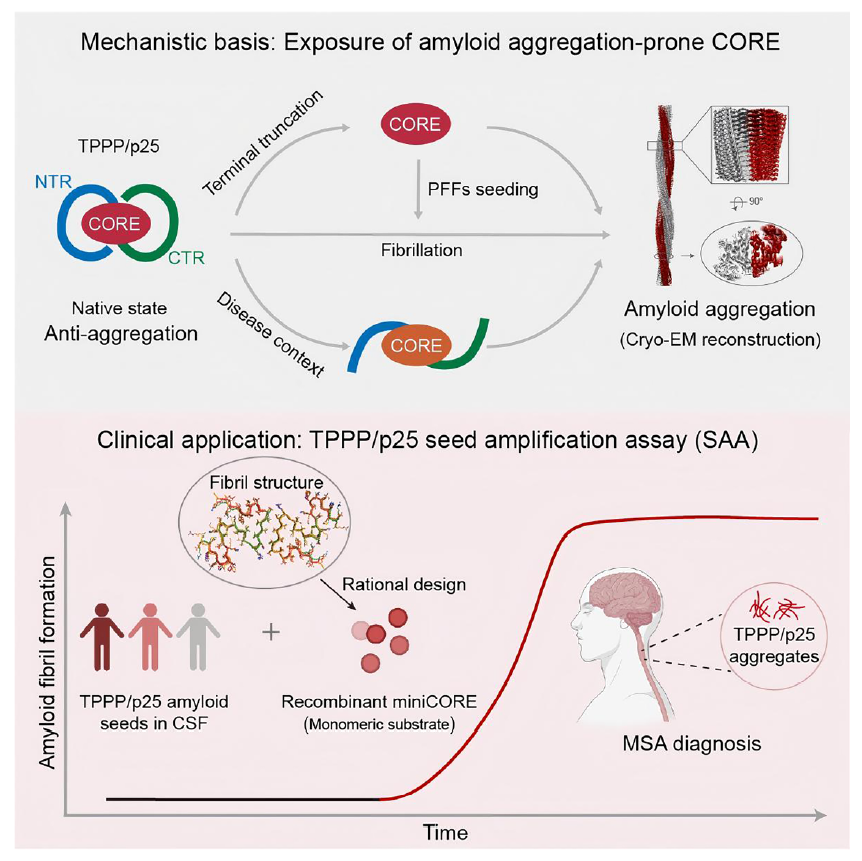
TPPP/p25 自抑制聚集的分子机制及 TPPP/p25-SAA 的建立与临床应用
全式金生物产品支撑
优质的试剂是科学研究的利器。全式金生物的 BL21(DE3) 感受态细胞 (CD601) 用于野生型/突变型 TPPP/p25 及其各个结构域(CORE, miniCORE, NTR, CTR)的蛋白表达。产品自上市以来,深受客户青睐,多次荣登知名期刊,助力科学研究。
BL21(DE3) Chemically Competent Cell (CD601)
本产品经特殊工艺制作,可用于 DNA 的化学转化。使用 pUC19 质粒 DNA 检测,转化效率高达 107 cfu/μg DNA。使用 Control Plasmid I (Amp+) 用于检测细胞是否具有表达功能,表达蛋白大小为 25 kDa。
产品特点:
• 该菌株用于 T7 RNA 聚合酶为表达系统的高效外源基因的蛋白表达宿主,T7 噬菌体 RNA 聚合酶基因的表达受控于 λ 噬菌体 DE3 区的 lacUV5 启动子,该区整合于 BL21 的染色体上。
• 该菌株适合于非毒性蛋白的表达。
全式金生物的产品再度亮相 Cell 期刊,不仅是对全式金生物产品卓越品质与雄厚实力的有力见证,更是生动展现了全式金生物长期秉持的“品质高于一切,精品服务客户”核心理念。一直以来,全式金生物凭借对品质的执着追求和对创新的不懈探索,其产品已成为众多科研工作者信赖的得力助手。展望未来,我们将持续推出更多优质产品,期望携手更多科研领域的杰出人才,共同攀登科学高峰,书写科研创新的辉煌篇章。
使用 BL21(DE3) Chemically Competent Cell (CD601) 产品发表的部分文章:
• Lan Z, Song Z, Wang Z, et al. Antagonistic RALF peptides control an intergeneric hybridization barrier on Brassicaceae stigmas[J]. Cell, 2023.(IF 64.50)
• Huang Y, Yang J, Sun X, et al. Perception of viral infections and initiation of antiviral defence in rice[J]. Nature, 2025(IF 50.50)
• Chen C C, Yu Z P, Liu Z W, et al. Chanoclavine synthase operates by an NADPH-independent superoxide mechanism[J]. Nature, 2025.(IF 50.50)
• Lu P, Cheng Y, Xue L, et al. Selective degradation of multimeric proteins by TRIM21-based molecular glue and PROTAC degraders[J]. Cell, 2024.(IF 45.60)
• Li H L, Zhang Y, Rao G, et al. Rift Valley fever virus coordinates the assembly of a programmable E3 ligase to promote viral replication[J]. Cell, 2024.(IF 45.60)
• Hu Q, Liu H, He Y, et al. Regulatory mechanisms of strigolactone perception in rice[J]. Cell, 2024.(IF 45.60)
• Wu K M, Xu Q H, Liu Y Q, et al. Neuronal FAM171A2 mediates a-synuclein fibril uptake and drives Parkinson’s disease [J]. Science, 2025.(IF 44.70)
• Zeng S Y, Zhang S Q, Zhang S N, et al. TPPP/p25 amyloid seeding activity as a specific biomarker for multiple system atrophy[J]. Cell, 2026(IF 42.50)
• Yang G Y, Wu M, Zhang S A, et al. Editing strigolactone hormone receptor for robust antiviral silencing in rice[J]. Cell, 2026.(IF 42.50)
• Deng Z, Pu L, Deng K, et al. Targeting TFAP2β condensation suppresses the development of esophageal squamous cell carcinoma[J]. Cell, 2025.(IF 42.50)
• Zhang J Y, Wang B, Xu H R, et al. Root microbiota regulates tiller number in rice[J]. Cell, 2025.(IF 42.50)
• Li X, Zhang Y, Xu L, et al. Ultrasensitive sensors reveal the spatiotemporal landscape of lactate metabolism in physiology and disease[J]. Cell Metabolism, 2023.(IF 27.70)
• Chen Y G, Li D S, Ling Y, et al. A cryptic plant terpene cyclase producing unconventional 18‐and 14‐membered macrocyclic C25 and C20 terpenoids with immunosuppressive activity[J]. Angewandte Chemie, 2021.(IF 16.10)
• Yang C, Wang Z, Kang Y, et al. Stress granule homeostasis is modulated by TRIM21-mediated ubiquitination of G3BP1 and autophagy-dependent elimination of stress granules[J]. Autophagy, 2023.(IF 14.60)
• Wang D, Xu C, Yang W, et al. E3 ligase RNF167 and deubiquitinase STAMBPL1 modulate mTOR and cancer progression[J]. Molecular cell, 2022.(IF 14.50)