文章信息
文章题目:Editing Strigolactone Hormone Receptor for Robust Antiviral Silencing in Rice
期刊:Cell
发表时间:2026 年 2 月 24 日
主要内容:福建农林大学农林生物安全全国重点实验室吴建国教授团队,联合加州大学河滨分校杰出教授丁守伟博士和清华大学闫利明研究员在 Cell 发表了题为“Editing Strigolactone Hormone Receptor for Robust Antiviral Silencing in Rice”的研究论文,在机制层面贯通了独脚金内酯激素信号通路与动植物中高度保守的抗病毒 RNA 干扰(RNAi)免疫体系,推动了植物免疫理论的重大跃升,实现了从机制发现到精准育种应用的完整闭环。
原文链接:
https://www.cell.com/cell/fulltext/S0092-8674(26)00100-5
使用 TransGen 产品:
• ProteinFind® Anti-c-Myc Mouse Monoclonal Antibody (HT101)
• ProteinFind® Anti-DYKDDDDK Mouse Monoclonal Antibody (HT201)
• ProteinFind® Anti-His Mouse Monoclonal Antibody (HT501)
• ProteinFind® Anti-GST Mouse Monoclonal Antibody (HT601)
• ProteinFind® Anti-MBP Mouse Monoclonal Antibody (HT701)
• Trans5α Chemically Competent Cell (CD201)
• BL21(DE3) Chemically Competent Cell (CD601)

背景介绍
独脚金内酯(Strigolactone,SL)是近年来鉴定的一类重要植物激素。研究发现,SL 调控植物分枝(分蘖)、茎秆伸长及根系发育等关键性状,还作为重要信号分子介导植物与共生真菌、寄生性杂草的互作。然而,对 SL 在植物免疫的调控及其在抗病育种中的应用,一直缺乏深入研究。RNA 干扰(RNAi)是动植物保守的抗病毒机制,但水稻抗病毒免疫的调控机制尚不清晰。
文章概述
研究发现,水稻病毒侵染或过表达草状矮化病毒(RGSV)的 P3 蛋白后,水稻出现矮化、分蘖增多等表型。通过遗传学和分子生物学分析,首次证实 SL 信号通路是水稻抗病毒免疫的必需通路,且具有广谱抗性,可抑制呼肠孤病毒目下多种重要水稻病毒。病毒侵染诱导转录因子 MID1 表达,MID1 激活抗病毒基因 RDR1 和 RDR6 的转录,这一过程依赖共转录激活因子 ONAC131 的协同作用。SL 信号通过维持 ONAC131 的表达水平,确保其有效辅助 MID1 启动下游抗病毒基因转录,增强 RNAi 介导的抗病毒免疫效应,首次建立了 SL 信号与 RNAi 通路的直接联系。
通过冷冻电镜解析 P3–D14 复合物的高分辨率结构,研究人员首次在原子层面看见病毒致病蛋白 P3 通过竞争性占据 D14 上的 D3 结合位点,阻断 D14–D3 复合物形成,从而切断独脚金内酯信号传导,揭示了病毒靶向宿主免疫枢纽实施反防御的分子机制。基于对病毒靶向独脚金内酯受体 D14 分子界面的精确解析,理性设计并创制了既维持正常激素功能、又能有效逃逸病毒攻击的 D14 突变体(D102A/N),并通过单碱基编辑技术将这一突变精准引入水稻基因组。改良材料在显著提升抗病毒能力的同时,株型、产量等关键农艺性状与常规品种无明显差异,成功实现了“抗病不减产”的育种目标。
该研究贯通了 SL 激素信号通路与 RNAi 抗病毒免疫体系,从机制层面揭示了 SL 信号调控水稻抗病毒免疫的分子机制,并通过精准编辑受体基因,实现了从理论发现到应用育种的闭环,为作物抗病毒育种提供了新的靶点和方法。
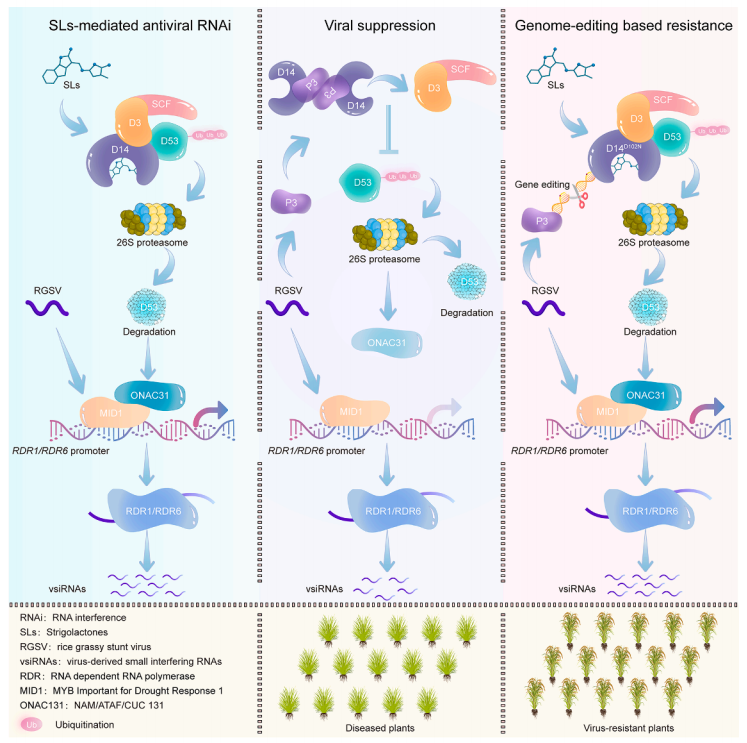
独脚金内酯信号介导水稻抗病机制及病毒反防御机制模式图
全式金生物产品支撑
优质的试剂是科学研究的利器。全式金生物的抗 c-Myc 标签鼠单克隆抗体 (HT101)、抗 DYKDDDDK 标签鼠单克隆抗体 (HT201)、抗 His 标签鼠单克隆抗体 (HT501)、抗 GST 标签鼠单克隆抗体 (HT601)、抗 MBP 标签鼠单克隆抗体 (HT701)、Trans5α 克隆感受态细胞(CD201)、BL21(DE3) 感受态细胞 (CD601) 助力本研究。产品自上市以来,深受客户青睐,多次荣登知名期刊,助力科学研究。
ProteinFind® Anti-c-Myc Mouse Monoclonal Antibody(HT101)
抗 c-Myc 标签鼠单克隆抗体为高纯度的小鼠单克隆抗体,属 IgG1 同型,免疫原为人工合成的人源 c-Myc 蛋白 C 端 410-419 位多肽序列 (EQKLISEEDL)。
产品特点:
• 高纯度的抗小鼠单克隆抗体,特异性强。
• 高度特异识别重组蛋白 C 末端或 N 末端的 c-Myc 标签 (EQKLISEEDL)。
• 用于定性或定量检测 c-Myc 融合表达蛋白。
ProteinFind® Anti-DYKDDDDK Mouse Monoclonal Antibody(HT201)
抗 DYKDDDDK 标签鼠单克隆抗体为高纯度的小鼠单克隆抗体,属 IgG1 同型,免疫原为人工合成的 DYKDDDDK 标签多肽序列。
产品特点:
• 高纯度的小鼠单克隆抗体, 特异性强。
• 高度特异识别重组蛋白 C 末端或 N 末端的 DYKDDDDK 标签。
• 适用于定性或定量检测 DYKDDDDK 融合表达蛋白。
ProteinFind® Anti-His Mouse Monoclonal Antibody (HT501)
抗 His 标签鼠单克隆抗体为高纯度的小鼠单克隆抗体,属 IgG1 同型,免疫原为人工合成的 6×His 标签多肽序列 (HHHHHH)。
产品特点
• 高纯度的抗小鼠单克隆抗体,特异性强。
• 高度特异识别重组蛋白 C 末端或 N 末端的 6×His 标签。
• 适用于定性或定量检测 His 融合表达蛋白。
ProteinFind® Anti-GST Mouse Monoclonal Antibody (HT601)
抗 GST 标签鼠单克隆抗体为高纯度的小鼠单克隆抗体,属 IgG2a 同型,免疫原为酵母 Y258 GST 重组表达蛋白。
产品特点
• 高纯度的小鼠单克隆抗体, 特异性强。
• 与 GST 结构域具有高亲和性,适用于特异性检测 GST 融合表达蛋白。
ProteinFind® Anti-MBP Mouse Monoclonal Antibody (HT701)
产品特点
抗 MBP 标签鼠单克隆抗体为高纯度的小鼠单克隆抗体,属 IgG2b 同型,免疫原为 E.coli MBP 重组表达蛋白。
• 高纯度的小鼠单克隆抗体 , 特异性强。
• 高度特异识别重组蛋白 C 末端或 N 末端的 MBP 标签 , 适用于特异性检测 MBP 融合表达蛋白。
Trans5α Chemically Competent Cell (CD201)
本产品经特殊工艺制作,可用于 DNA 的化学转化。使用 pUC19 质粒 DNA 检测,转化效率高达 108 cfu/μg DNA 以上。
产品特点:
• 适用于蓝白斑筛选。
• rec A1 和 end A1 的突变有利于克隆 DNA 的稳定和高纯度质粒 DNA 的提取。
BL21(DE3) Chemically Competent Cell (CD601)
本产品经特殊工艺制作,可用于 DNA 的化学转化。使用 pUC19 质粒 DNA 检测,转化效率高达 107 cfu/μg DNA。使用 Control Plasmid I (Amp+) 用于检测细胞是否具有表达功能,表达蛋白大小为 25 kDa。
产品特点:
• 该菌株用于 T7 RNA 聚合酶为表达系统的高效外源基因的蛋白表达宿主,T7 噬菌体 RNA 聚合酶基因的表达受控于 λ 噬菌体 DE3 区的 lacUV5 启动子,该区整合于 BL21 的染色体上。
• 该菌株适合于非毒性蛋白的表达。
全式金生物的产品再度亮相 Cell 期刊,不仅是对全式金生物产品卓越品质与雄厚实力的有力见证,更是生动展现了全式金生物长期秉持的“品质高于一切,精品服务客户”核心理念。一直以来,全式金生物凭借对品质的执着追求和对创新的不懈探索,其产品已成为众多科研工作者信赖的得力助手。展望未来,我们将持续推出更多优质产品,期望携手更多科研领域的杰出人才,共同攀登科学高峰,书写科研创新的辉煌篇章。
使用 ProteinFind® Anti-c-Myc Mouse Monoclonal Antibody(HT101)产品发表的部分文章:
• Yang G Y, Wu M, Zhang S A, et al. Editing strigolactone hormone receptor for robust antiviral silencing in rice[J]. Cell, 2026.(IF 45.50)
• Shi J Y,Mei G, Ge F Y, et al. Resistance to Striga Parasitism through Reduction of Strigolactone Exudation[J]. Cell, 2025.(IF 45.50)
• Zeng R, Shi Y, Guo L, et al. A natural variant of COOL1 gene enhances cold tolerance for high-latitude adaptation in maize[J]. Cell, 2025.(IF 45.50)
• Wang J D, Wang J, Huang L C, et al. ABA-mediated regulation of rice grain quality and seed dormancy via the NF-YB1-SLRL2-bHLH144 Module[J]. Nature Communications, 2024.(IF 14.70)
• Zhang H, Huang C, Gao C, et al. Evolutionary-Distinct Viral Proteins Subvert Rice Broad-Spectrum Antiviral Immunity Mediated by the RAV15-MYC2 Module[J]. Advanced science (Weinheim, Baden-Wurttemberg, Germany), 2025.(IF 14.30)
• Li J, Liu X, Chang S, et al. The potassium transporter TaNHX2 interacts with TaGAD1 to promote drought tolerance via modulating stomatal aperture in wheat[J]. Science Advances, 2024.(IF 11.70)
• Du D, Li Z, Yuan J, et al. The TaWAK2-TaNAL1-TaDST pathway regulates leaf width via cytokinin signaling in wheat[J]. Science Advances, 2024.(IF 11.70)
使用 ProteinFind® Anti-DYKDDDDK Mouse Monoclonal Antibody(HT201)产品发表的部分文章:
• Huang Y, Yang J, Sun X, et al. Perception of viral infections and initiation of antiviral defence in rice[J]. Nature, 2025(IF 50.50)
• Yang G Y, Wu M, Zhang S A, et al. Editing strigolactone hormone receptor for robust antiviral silencing in rice[J]. Cell, 2026.(IF 45.50)
• Zhao S, Makarova K S, Zheng W, et al. Widespread photosynthesis reaction centre barrel proteins are necessary for haloarchaeal cell division[J]. Nature Microbiology, 2024.(IF 28.30)
• Zhu Q, Ahmad A, Shi C, et al. Protein arginine methyltransferase 6 mediates antiviral immunity in plants[J]. Cell Host & Microbe, 2024.(IF 20.60)
• Cao W, Wang H, Quan M, et al. Reversible control of tetrazine bioorthogonal reactivity by naphthotube-mediated host-guest recognition[J]. Chem, 2023.(IF 19.10)
• Cheng A, Xu T, You W, et al. A mitotic NADPH upsurge promotes chromosome segregation and tumour progression in aneuploid cancer cells[J]. Nature Metabolism, 2023.(IF 18.90)
• Feng L, Luo X, Huang L, et al. A viral protein activates the MAPK pathway to promote viral infection by downregulating callose deposition in plants[J]. Nature Communications, 2024,(IF 14.70)
• Zhang H, Huang C, Gao C, et al. Evolutionary-Distinct Viral Proteins Subvert Rice Broad-Spectrum Antiviral Immunity Mediated by the RAV15-MYC2 Module[J]. Advanced science (Weinheim, Baden-Wurttemberg, Germany), 2025.(IF 14.30)
使用 ProteinFind® Anti-His Mouse Monoclonal Antibody (HT501) 产品发表的部分文章:
• Yang G Y, Wu M, Zhang S A, et al. Editing strigolactone hormone receptor for robust antiviral silencing in rice[J]. Cell, 2026.(IF 45.50)
• Dhungel B P, Xu H, Nagarajah R, et al. An alternate receptor for adeno-associated viruses [J]. Cell, 2025.(IF 45.50)
• Ou X M, Ma C Y, Sun D J, et al. SecY translocon chaperones protein folding during membrane protein insertion [J]. Cell, 2025.(IF 45.50)
• Zhao P Z, Yang H, Sun J Y, et al. Targeted MYC2 stabilization confers citrus Huanglongbing resistance [J]. Science, 2025.(IF 44.70)
• Lu P, Zhang G H, Li J, et al. A wheat tandem kinase and NLR pair confers resistance to multiple fungal pathogens[J]. Science, 2025.(IF 44.70)
• Li Y, Shen H, Zhang R, et al. Immunoglobulin M perception by FcμR[J]. Nature, 2023.(IF 50.50)
• Lan Z, Song Z, Wang Z, et al. Antagonistic RALF peptides control an intergeneric hybridization barrier on Brassicaceae stigmas[J]. Cell, 2023.(IF 45.50)
• Zhong S, Li L, Wang Z, et al. RALF peptide signaling controls the polytubey block in Arabidopsis[J]. Science, 2022.(IF 44.70)
使用 ProteinFind® Anti-GST Mouse Monoclonal Antibody (HT601) 产品发表的部分文章:
• Yang G Y, Wu M, Zhang S A, et al. Editing strigolactone hormone receptor for robust antiviral silencing in rice[J]. Cell, 2026.(IF 45.50)
• Zhao P Z, Yang H, Sun J Y, et al. Targeted MYC2 stabilization confers citrus Huanglongbing resistance [J]. Science, 2025.(IF 44.70)
• Lu P, Zhang G H, Li J, et al. A wheat tandem kinase and NLR pair confers resistance to multiple fungal pathogens[J]. Science, 2025.(IF 44.70)
• Feng L, Luo X, Huang L, et al. A viral protein activates the MAPK pathway to promote viral infection by downregulating callose deposition in plants[J]. Nature Communications, 2024,.(IF 14.70)
• Li J, Liu X, Chang S, et al. The potassium transporter TaNHX2 interacts with TaGAD1 to promote drought tolerance via modulating stomatal aperture in wheat[J]. Science Advances, 2024.(IF 11.70)
• Zhou B, Luo Q, Shen Y, et al. Coordinated regulation of vegetative phase change by brassinosteroids and the age pathway in Arabidopsis[J]. Nature Communications, 2023.(IF 14.70)
使用 ProteinFind® Anti-MBP Mouse Monoclonal Antibody (HT701) 产品发表的部分文章:
• Yang G Y, Wu M, Zhang S A, et al. Editing strigolactone hormone receptor for robust antiviral silencing in rice[J]. Cell, 2026.(IF 45.50)
• Ge L, Cao B, Qiao R, et al. SUMOylation-modified Pelota-Hbs1 RNA surveillance complex restricts the infection of potyvirids in plants[J]. Molecular Plant, 2023.(IF 21.95)
• Shi W, Wang L, Yao L, et al. Spatially patterned hydrogen peroxide orchestrates stomatal development in Arabidopsis[J]. Nature Communications, 2022.(IF 17.69)
• Ge L, Jia M, Shan H, et al. Viral RNA polymerase as a SUMOylation decoy inhibits RNA quality control to promote potyvirus infection[J]. Nature Communications, 2025.(IF 15.70)
• Shi W, Liu Y, Zhao N, et al. Hydrogen peroxide is required for light-induced stomatal opening across different plant species[J]. Nature Communications, 2024.(IF 14.70)
• Ma A, Zhang D, Wang G, et al. Verticillium dahliae effector VDAL protects MYB6 from degradation by interacting with PUB25 and PUB26 E3 ligases to enhance Verticillium wilt resistance[J]. The Plant Cell, 2021.(IF 11.27)
• Meng F, Zheng X, Wang J, et al. The GRAS protein OsDLA involves in brassinosteroid signalling and positively regulates blast resistance by forming a module with GSK2 and OsWRKY53 in rice[J]. Plant biotechnology journal, 2024.(IF 11.20)
• Liu Y, Yu T F, Li Y T, et al. Mitogen-activated protein kinase TaMPK3 suppresses ABA response by destabilising TaPYL4 receptor in wheat[J]. New Phytologist, 2022.(IF 10.32)
使用 Trans5α Chemically Competent Cell (CD201) 产品发表的部分文章:
• Zhong S, Ding W, Sun L, et al. Decoding the development of the human hippocampus[J]. Nature, 2020.(IF 50.50)
• Yang G Y, Wu M, Zhang S A, et al. Editing strigolactone hormone receptor for robust antiviral silencing in rice[J]. Cell, 2026.(IF 45.50)
• Han X, Zhang M H, Rong N K, et al. Mechanistic Insights into Fatty Acid Odor Detection Mediated by Class II Olfactory Receptors[J]. Cell, 2025.(IF 45.50)
• Ge X Y, Cheng J, Zhang L J, et al. Identification of Or5v1/Olfr110 as an oxylipin receptor and anti-obesity target[J]. Cell, 2025.(IF 45.50)
• Zhang X, Zhang Y, Liu X, et al. FOCAS: Transcriptome-wide screening of individual m6A sites functionally dissects epitranscriptomic control of gene expression in cancer[J]. Cell, 2025.(IF 45.50)
• Wang J L, Sha X Y, Shao Y,et al. Elucidating pathway-selective biased CCKBR agonism for Alzheimer's disease treatment[J]. Cell, 2025.(IF 45.50)
• Kang X, Li X R, Zhou J Q, et al. Extrachromosomal DNA replication and maintenance couple with DNA damage pathway in tumors[J]. Cell, 2025.(IF 45.50)
• Jiang Y, Dai A R, Huang Y W, et al. Ligand-induced ubiquitination unleashes LAG3 immune checkpoint function by hindering membrane sequestration of signaling motifs[J]. Cell, 2025.(IF 45.50)
• Ou X M, Ma C Y, Sun D J, et al. SecY translocon chaperones protein folding during membrane protein insertion[J]. Cell, 2025.(IF 45.50)
• Zhao Y, Ping Y Q, Wang M W, et al. Identification, structure and agonist design of an androgen membrane receptor[J]. Cell, 2025.(IF 45.50)
• Wen X, Shang P, Chen H D, et al. Evolutionary study and structural basis of proton sensing by Mus GPR4 and Xenopus GPR4[J]. Cell, 2025.(IF 45.50)
• Hu Q L, Liu H H, He Y J, et al. Regulatory mechanisms of strigolactone perception in rice [J]. Cell, 2024.(IF 45.50)
• Shang P, Rong N, Jiang J J, et al. Structural and signaling mechanisms of TAAR1 enabled preferential agonist design[J]. Cell, 2023.(IF 45.50)
• Ma X J, Wang W, Zhang J Y, et al. NRT1.1B acts as an abscisic acid receptor in integrating compound environmental cues for plants[J]. Cell, 2025.(IF 45.50)
• Jiang L, Xie X, Su N, et al. Large Stokes shift fluorescent RNAs for dual-emission fluorescence and bioluminescence imaging in live cells[J]. Nature Methods, 2023.(IF 36.10)
使用 BL21(DE3) Chemically Competent Cell (CD601) 产品发表的部分文章:
• Huang Y, Yang J, Sun X, et al. Perception of viral infections and initiation of antiviral defence in rice[J]. Nature, 2025(IF 50.50)
• Chen C C, Yu Z P, Liu Z W, et al. Chanoclavine synthase operates by an NADPH-independent superoxide mechanism[J]. Nature, 2025.(IF 50.50)
• Yang G Y, Wu M, Zhang S A, et al. Editing strigolactone hormone receptor for robust antiviral silencing in rice[J]. Cell, 2026.(IF 45.50)
• Wu K M, Xu Q H, Liu Y Q, et al. Neuronal FAM171A2 mediates a-synuclein fibril uptake and drives Parkinson’s disease [J]. Science, 2025.(IF 44.70)
• Deng Z, Pu L, Deng K, et al. Targeting TFAP2β condensation suppresses the development of esophageal squamous cell carcinoma[J]. Cell, 2025.(IF 45.50)
• Zhang J Y, Wang B, Xu H R, et al. Root microbiota regulates tiller number in rice[J]. Cell, 2025.(IF 45.50)
• Lu P, Cheng Y, Xue L, et al. Selective degradation of multimeric proteins by TRIM21-based molecular glue and PROTAC degraders[J]. Cell, 2024.(IF 45.50)
• Li H L, Zhang Y, Rao G, et al. Rift Valley fever virus coordinates the assembly of a programmable E3 ligase to promote viral replication[J]. Cell, 2024.(IF 45.50)
• Hu Q, Liu H, He Y, et al. Regulatory mechanisms of strigolactone perception in rice[J]. Cell, 2024.(IF 45.50)
• Lan Z, Song Z, Wang Z, et al. Antagonistic RALF peptides control an intergeneric hybridization barrier on Brassicaceae stigmas[J]. Cell, 2023.(IF 45.50)
• Li X, Zhang Y, Xu L, et al. Ultrasensitive sensors reveal the spatiotemporal landscape of lactate metabolism in physiology and disease[J]. Cell Metabolism, 2023.(IF 27.70)
• Chen Y G, Li D S, Ling Y, et al. A cryptic plant terpene cyclase producing unconventional 18‐and 14‐membered macrocyclic C25 and C20 terpenoids with immunosuppressive activity[J]. Angewandte Chemie, 2021.(IF 16.10)
• Yang C, Wang Z, Kang Y, et al. Stress granule homeostasis is modulated by TRIM21-mediated ubiquitination of G3BP1 and autophagy-dependent elimination of stress granules[J]. Autophagy, 2023.(IF 14.60)
• Wang D, Xu C, Yang W, et al. E3 ligase RNF167 and deubiquitinase STAMBPL1 modulate mTOR and cancer progression[J]. Molecular cell, 2022.(IF 14.50)