文章信息
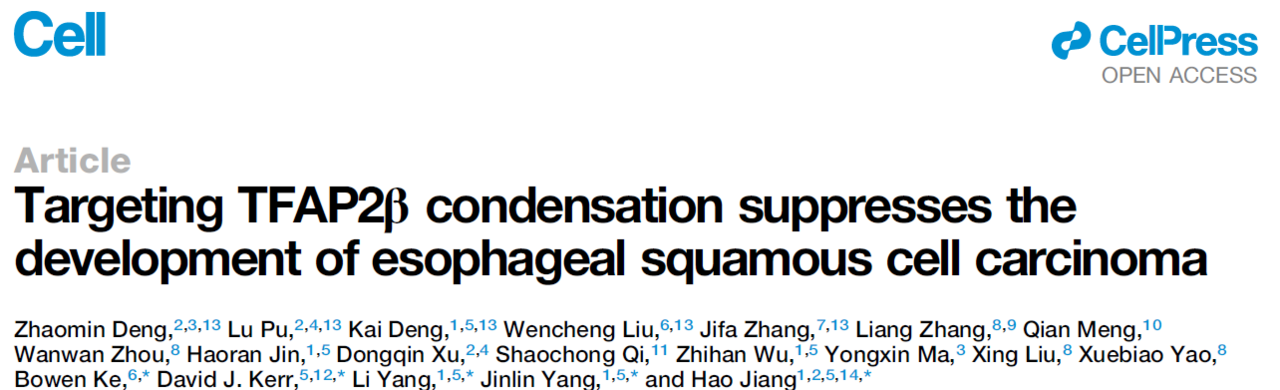
文章题目:Targeting TFAP2β condensation suppresses the development of esophageal squamous cell carcinoma
期刊:Cell
发表时间:2025 年 12 月 16 日
主要内容:四川大学华西医院姜昊、杨锦林、杨丽和柯博文团队与牛津大学 David Kerr 团队合作,在 Cell 上发表题为“Targeting TFAP2β condensation suppresses the development of esophageal squamous cell carcinoma”的研究论文。该研究通过改进 ATAC-seq 建库技术,首次在早期 ESCC 组织中系统解析染色质可及性与转录调控网络,锁定转录因子 TFAP2β 为关键下调分子,并揭示其通过相分离形成核内凝聚体,进而抑制下游致癌基因 ZNF131 的表达,调控 ESCC 进展。更令人振奋的是,团队通过虚拟筛选发现小分子化合物 A6,可特异性增强 TFAP2β 的相分离能力,在细胞、小鼠及人源类器官模型中均表现出显著抗肿瘤效果。
原文链接:
https://www.cell.com/cell/fulltext/S0092-8674(25)01315-7
使用TransGen产品:
• pEASY® -Uni Seamless Cloning and Assembly Kit (CU101)
• Trans5α Chemically Competent Cell (CD201)
• BL21(DE3) Chemically Competent Cell (CD601)
背景介绍
食管鳞状细胞癌(ESCC)在食管癌中最为常见,约占全部病例的 90%,致死率高且治疗手段有限。目前临床采用手术、放化疗及抗 HER-2、PD-L1 等靶向疗法,但总体效果仍不理想,患者五年生存率较低。近年来,液-液相分离(LLPS)作为一种形成细胞内无膜细胞器的重要机制,被发现广泛参与基因转录调控、信号转导及疾病发生过程,正逐步成为干预疾病的新潜在靶点。
文章概述
TFAP2β 的发现之路
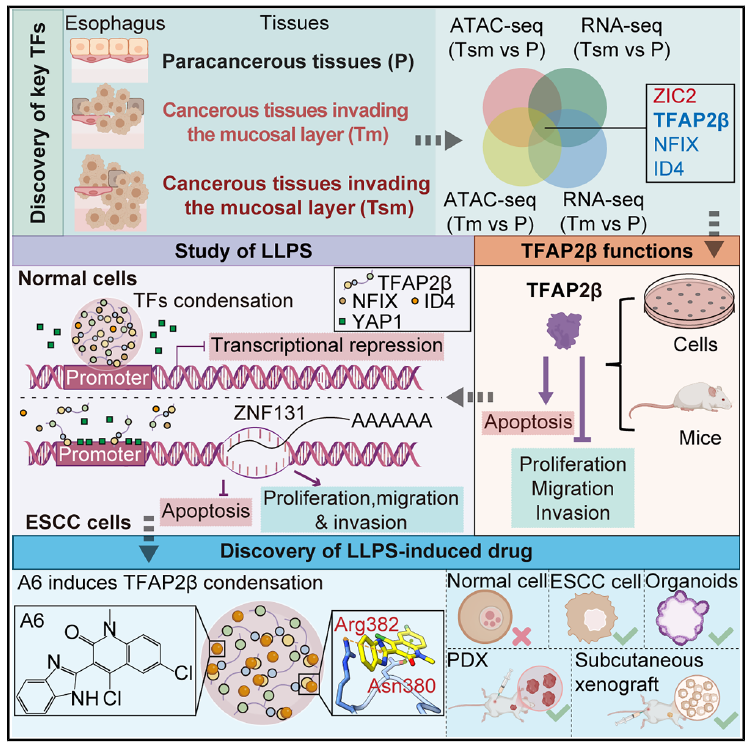
研究团队针对临床样本量有限、ATAC-seq建库技术难度大的问题,通过系统性优化建库流程,将建库成功率提升至 80% 以上。在此基础上,他们对 28 例早期 ESCC 患者的癌组织及癌旁组织同时进行了 ATAC-seq 和 RNA-seq 分析。通过多组学数据分析,发现 TFAP2β 是癌组织中一致性下调的关键转录因子,其低表达水平与患者不良预后相关。
TFAP2β 不仅转录因子,还是个“相分离能手”
TFAP2β 蛋白包含介导相分离的关键结构域——内在无序区(IDR),研究表明,在正常食管上皮细胞核内,TFAP2β 能够形成动态的液滴状凝聚体;而在 ESCC 细胞中,这一凝聚现象显著减弱。研究团队通过细胞内 FRAP、CLEM、体外重组蛋白液滴形成、FRAP、fusion、DLS 等多角度实验,系统验证了 TFAP2β 的相分离特性。进一步机制探索发现,其相分离能力依赖于 IDR2 中保守的带正电荷氨基酸残基:一旦这些残基发生突变,TFAP2β 不仅丧失凝聚能力,其抑癌功能也明显下降。
凝聚体招募 NFIX 和 ID4、抑制致癌基因
进一步研究揭示,TFAP2β 凝聚体能够特异性地结合下游靶基因 ZNF131 的启动子区域,并抑制其转录活性。ZNF131 在 ESCC 中呈现高表达,具有促进肿瘤发展的作用。此外,TFAP2β 凝聚体还能协同招募 NFIX 和 ID4 这两种在 ESCC 中表达下调的转录因子,增强它们与 DNA 的结合能力,从而协同调控基因表达。这一发现提示,相分离现象可能是 ESCC 中转录调控的一个普遍机制。
从机制到疗法:小分子 A6 促凝聚,实现精准打击
基于 TFAP2β 的结构特征,研究团队通过构建虚拟筛选体系,从化合物库中成功筛选出能增强其相分离能力的小分子 A6。结构模拟与氢氘交换质谱分析显示,A6 结合在 TFAP2β 的 DNA 结合结构域附近,借助 Arg382 与 Asn380 两个关键残基稳定蛋白构象,从而间接促进 IDR2 有序化并增强相分离。在 ESCC 细胞、小鼠移植瘤模型以及患者来源类器官实验中,A6 均能显著促进 TFAP2 在核内形成凝聚体,有效抑制细胞增殖、迁移和侵袭,并诱导细胞凋亡,且对正常食管上皮细胞影响较小。值得注意的是,在 TFAP2β 敲除或突变细胞中,A6 的抗肿瘤作用基本消失,证明其疗效高度依赖于 TFAP2β 的相分离功能。
该研究不仅揭示了 TFAP2β 相分离在 ESCC 转录调控与肿瘤抑制中的双重功能,更首次提出了“通过小分子调控转录因子相分离”的 ESCC 靶向治疗新策略。A6 作为首个针对 ESCC 相分离机制的候选化合物,显示出良好的细胞与动物水平疗效,为后续临床转化提供了重要依据。
全式金生物产品支撑
优质的试剂是科学研究的利器。全式金生物的通用版同源重组无缝克隆试剂盒(CU101)、Trans5α 克隆感受态细胞(CD201)和 BL21(DE3) 感受态细胞 (CD601) 助力本研究。产品自上市以来,深受客户青睐,多次荣登知名期刊,助力科学研究。
pEASY® -Uni Seamless Cloning and Assembly Kit (CU101)
本产品利用特殊的重组酶和同源重组的原理,可以将任意方法线性化后的载体和与其两端具有 15-25 bp 重叠区域的 PCR 片段定向重组,可以实现最多 15 个片段的高效无缝拼接。
产品特点
• 阳性率高,克隆数多。
• 高效连接:最高可实现 15 个片段无缝连接。
• 快速重组:5-15 min 即可完成反应。
• 大容量组装:可成功构建 31.8 kb 的质粒 (载体+片段)。
• 长载体组装:支持 14 kb 长载体组装。
• 广谱兼容:支持低浓度 (0.003 pmol) 单片段、多片段高效连接。
• 提供在线引物设计软件:智能在线工具,快速生成高特异性引物。
Trans5α Chemically Competent Cell (CD201)
本产品经特殊工艺制作,可用于 DNA 的化学转化。使用 pUC19 质粒 DNA 检测,转化效率高达 108 cfu/μg DNA 以上。
产品特点
• 适用于蓝白斑筛选。
• rec A1 和 end A1 的突变有利于克隆 DNA 的稳定和高纯度质粒 DNA 的提取。
BL21(DE3) Chemically Competent Cell (CD601)
本产品经特殊工艺制作,可用于 DNA 的化学转化。使用 pUC19 质粒 DNA 检测,转化效率高达 107 cfu/μg DNA。使用 Control Plasmid I (Amp+) 用于检测细胞是否具有表达功能,表达蛋白大小为 25 kDa。
产品特点
• 该菌株用于 T7 RNA 聚合酶为表达系统的高效外源基因的蛋白表达宿主,T7 噬菌体RNA 聚合酶基因的表达受控于 λ 噬菌体 DE3 区的 lacUV5 启动子,该区整合于 BL21 的染色体上。
• 该菌株适合于非毒性蛋白的表达。
全式金生物的产品再度亮相 Cell 期刊,不仅是对全式金生物产品卓越品质与雄厚实力的有力见证,更是生动展现了全式金生物长期秉持的“品质高于一切,精品服务客户”核心理念。一直以来,全式金生物凭借对品质的执着追求和对创新的不懈探索,其产品已成为众多科研工作者信赖的得力助手。展望未来,我们将持续推出更多优质产品,期望携手更多科研领域的杰出人才,共同攀登科学高峰,书写科研创新的辉煌篇章。
使用 pEASY® -Uni Seamless Cloning and Assembly Kit(CU101)产品发表的部分文章:
• Xu Y, Zhu T F. Mirror-image T7 transcription of chirally inverted ribosomal and functional RNAs[J]. Science, 2022.(IF 63.71)
• Deng Z, Pu L, Deng K, et al. Targeting TFAP2β condensation suppresses the development of esophageal squamous cell carcinoma[J]. Cell, 2025.(IF 42.50)
• Zhu Z, Wang Y, Liu S, et al. Genomic atlas of 8,105 accessions reveals stepwise domestication, global dissemination, and improvement trajectories in soybean[J]. Cell, 2025.(IF 42.50)
• Shi J, Mei C, Ge F, et al. Resistance to Striga parasitism through reduction of strigolactone exudation[J]. Cell, 2025.(IF 42.50)
• Bai X, Sun P, Wang X, et al. Structure and dynamics of the EGFR/HER2 heterodimer[J]. Cell Discovery, 2023.(IF 38.07)
• Wang H, Yang J, Cai Y, et al. Macrophages suppress cardiac reprogramming of fibroblasts in vivo via IFN-mediated intercellular self-stimulating circuit[J]. Protein & Cell, 2024.(IF 21.10)
• Xu J, Liang Y, Li N, et al. Clathrin-associated carriers enable recycling through a kiss-and-run mechanism[J]. Nature Cell Biology, 2024.(IF 17.30)
• Li B, Zhu L, Lu C, et al. circNDUFB2 inhibits non-small cell lung cancer progression via destabilizing IGF2BPs and activating anti-tumor immunity[J]. Nature communications, 2021.(IF 14.92)
• Shi C, Yang X, Hou Y, et al. USP15 promotes cGAS activation through deubiquitylation and liquid condensation[J]. Nucleic Acids Research, 2022.(IF 14.90)
• Wang J, An Z, Wu Z, et al. Spatial organization of PI3K-PI (3, 4, 5) P3-AKT signaling by focal adhesions[J]. Molecular Cell, 2024.(IF 14.50)
• Liu S, Fan L, Liu Z, et al. A Pd1–Ps–P1 feedback loop controls pubescence density in soybean[J]. Molecular plant, 2020.(IF 12.08)
• Jin Q, Yang X, Gou S, et al. Double knock-in pig models with elements of binary Tet-On and phiC31 integrase systems for controllable and switchable gene expression[J]. Science China Life Sciences, 2022.(IF 10.37)
• Mu S, Chen H, Li Q, et al. Enhancing prime editor flexibility with coiled-coil heterodimers[J]. Genome Biology, 2024.(IF 10.10)
• Du G, Xiong L, Li X, et al. Peroxisome elevation induces stem cell differentiation and intestinal epithelial repair[J]. Developmental cell, 2020. (IF 10.09)
• Tang Y, Gao C C, Gao Y, et al. OsNSUN2-mediated 5-methylcytosine mRNA modification enhances rice adaptation to high temperature[J]. Developmental cell, 2020.(IF 10.09)
使用 Trans5α Chemically Competent Cell (CD201) 产品发表的部分文章:
• Zhong S, Ding W, Sun L, et al. Decoding the development of the human hippocampus[J]. Nature, 2020.(IF 50.50)
• Deng Z, Pu L, Deng K, et al. Targeting TFAP2β condensation suppresses the development of esophageal squamous cell carcinoma[J]. Cell, 2025.(IF 42.50)
• Wang J L, Sha X Y, Shao Y,et al. Elucidating pathway-selective biased CCKBR agonism for Alzheimer's disease treatment[J]. Cell, 2025.(IF 42.50)
• Kang X, Li X R, Zhou J Q, et al. Extrachromosomal DNA replication and maintenance couple with DNA damage pathway in tumors[J]. Cell, 2025.(IF 42.50)
• Jiang Y, Dai A R, Huang Y W, et al. Ligand-induced ubiquitination unleashes LAG3 immune checkpoint function by hindering membrane sequestration of signaling motifs[J]. Cell, 2025.(IF 42.50)
• Ou X M, Ma C Y, Sun D J, et al. SecY translocon chaperones protein folding during membrane protein insertion[J]. Cell, 2025.(IF 42.50)
• Zhao Y, Ping Y Q, Wang M W, et al. Identification, structure and agonist design of an androgen membrane receptor[J]. Cell, 2025.(IF 42.50)
• Wen X, Shang P, Chen H D, et al. Evolutionary study and structural basis of proton sensing by Mus GPR4 and Xenopus GPR4[J]. Cell, 2025.(IF 42.50)
• Ma X J, Wang W, Zhang J Y, et al. NRT1.1B acts as an abscisic acid receptor in integrating compound environmental cues for plants[J]. Cell, 2025.(IF 42.50)
• Hu Q L, Liu H H, He Y J, et al. Regulatory mechanisms of strigolactone perception in rice [J]. Cell, 2024.(IF 45.50)
• Shang P, Rong N, Jiang J J, et al. Structural and signaling mechanisms of TAAR1 enabled preferential agonist design[J]. Cell, 2023.(IF 45.50)
• Jiang L, Xie X, Su N, et al. Large Stokes shift fluorescent RNAs for dual-emission fluorescence and bioluminescence imaging in live cells[J]. Nature Methods, 2023.(IF 36.10)
使用 BL21(DE3) Chemically Competent Cell (CD601)产品发表的部分文章:
• Huang Y, Yang J, Sun X, et al. Perception of viral infections and initiation of antiviral defence in rice[J]. Nature, 2025(IF 50.50)
• Chen C C, Yu Z P, Liu Z W, et al. Chanoclavine synthase operates by an NADPH-independent superoxide mechanism[J]. Nature, 2025.(IF 50.50)
• Wu K M, Xu Q H, Liu Y Q, et al. Neuronal FAM171A2 mediates a-synuclein fibril uptake and drives Parkinson’s disease [J]. Science, 2025.(IF 44.70)
• Deng Z, Pu L, Deng K, et al. Targeting TFAP2β condensation suppresses the development of esophageal squamous cell carcinoma[J]. Cell, 2025.(IF 42.50)
• Zhang J Y, Wang B, Xu H R, et al. Root microbiota regulates tiller number in rice[J]. Cell, 2025.(IF 42.50)
• Lu P, Cheng Y, Xue L, et al. Selective degradation of multimeric proteins by TRIM21-based molecular glue and PROTAC degraders[J]. Cell, 2024.(IF 45.50)
• Li H L, Zhang Y, Rao G, et al. Rift Valley fever virus coordinates the assembly of a programmable E3 ligase to promote viral replication[J]. Cell, 2024.(IF 45.50)
• Hu Q, Liu H, He Y, et al. Regulatory mechanisms of strigolactone perception in rice[J]. Cell, 2024.(IF 45.50)
• Lan Z, Song Z, Wang Z, et al. Antagonistic RALF peptides control an intergeneric hybridization barrier on Brassicaceae stigmas[J]. Cell, 2023.(IF 45.50)
• Li X, Zhang Y, Xu L, et al. Ultrasensitive sensors reveal the spatiotemporal landscape of lactate metabolism in physiology and disease[J]. Cell Metabolism, 2023.(IF 27.70)
• Yang C, Wang Z, Kang Y, et al. Stress granule homeostasis is modulated by TRIM21-mediated ubiquitination of G3BP1 and autophagy-dependent elimination of stress granules[J]. Autophagy, 2023.(IF 14.60)
• Wang D, Xu C, Yang W, et al. E3 ligase RNF167 and deubiquitinase STAMBPL1 modulate mTOR and cancer progression[J]. Molecular cell, 2022.(IF 14.50)
• Chen Y G, Li D S, Ling Y, et al. A cryptic plant terpene cyclase producing unconventional 18‐and 14‐membered macrocyclic C25 and C20 terpenoids with immunosuppressive activity[J]. Angewandte Chemie, 2021.(IF 16.10)